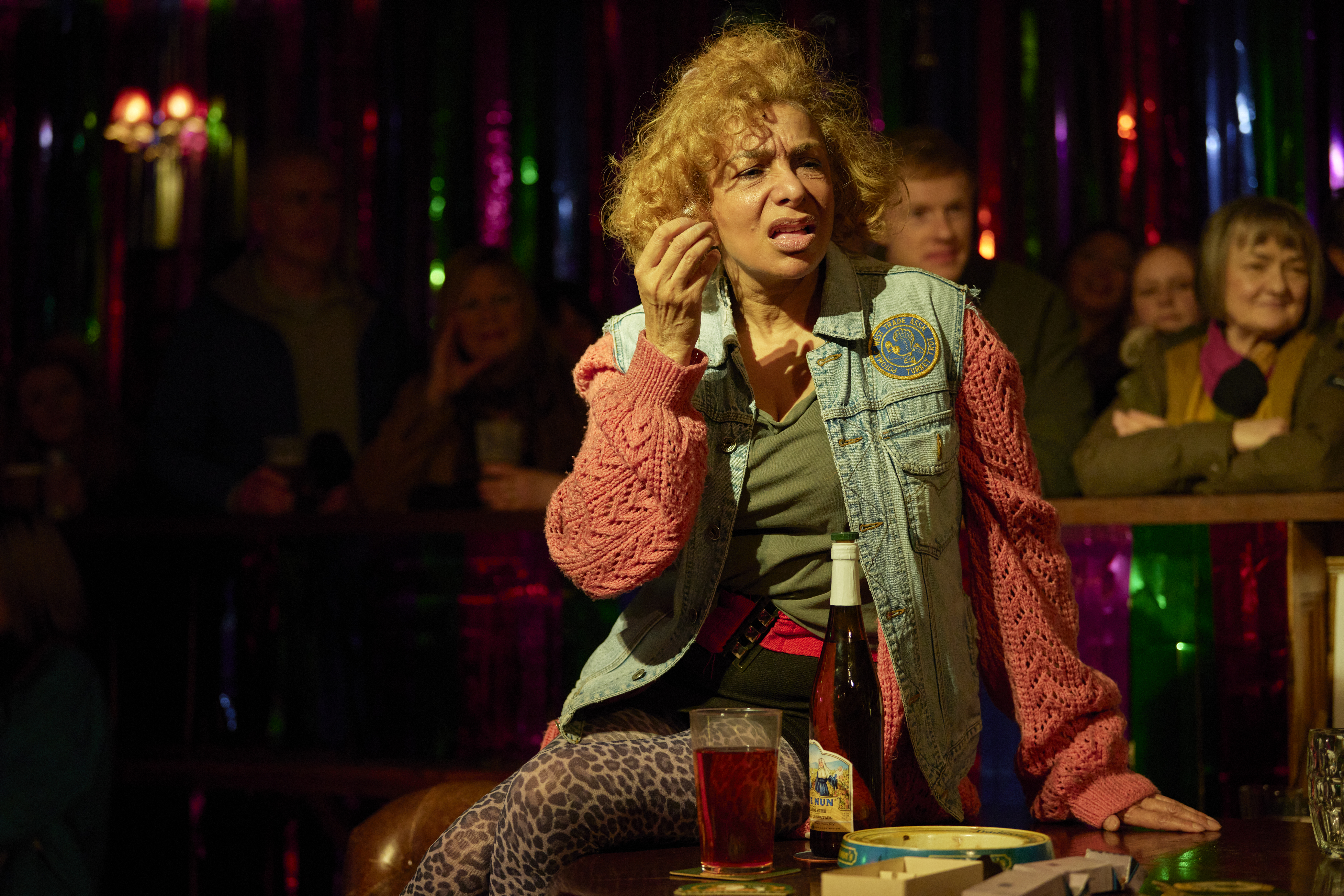
Review of Road at Royal Exchange, Manchester.
Telegraph poles have sprouted within the Royal Exchange’s Great Hall, a van sits abandoned near the toilets, and a chippie awaits around the corner.
Selina Cartmell’s revival of Jim Cartwright’s Road pulls you into its chaotic, clammy embrace as soon as you step through the main doors.
Gradually characters appear, on balconies, in a side room, next to the bar. Getting ready for a night out, watching TV, arguing, mingling, or just silently slipping past.
Overhead, telephone wires, electric cabling & video tape form a vast web, hinting at a community both tangled together and trapped.
Designer Leslie Travers’ attention to detail is quite something. The stage floor is flecked with splash and spillage, and the fading outlines of long-gone carpet. A deflated space hopper hangs from the side of a lamppost, a bright orange rictus grin – on stage, hope is on slow puncture, gradually leaking out of Cartwright’s characters.
Forty years after it was first performed, Road still retains its bite. Although it was forged in the bitterness of Thatcherism, it doesn’t feel stuck in that past. To our shame, seen-better-days-places, peopled by the left-behind and casually discarded, still endure.
Road’s residents can vividly recall those times before cuts and closures, almost taste them. Their talk is full of yearning – occasionally, in Cartmell’s production, they look skywards beseechingly, as if invoking a higher power to come and save them from what they’ve become.
The Exchange’s emerging addiction to celebrity casting undoubtedly sells tickets. Fortunately, here, unlike Kym Marsh’s toothless turn in last year’s Abigail’s Party, the approach also pays artistic dividends.
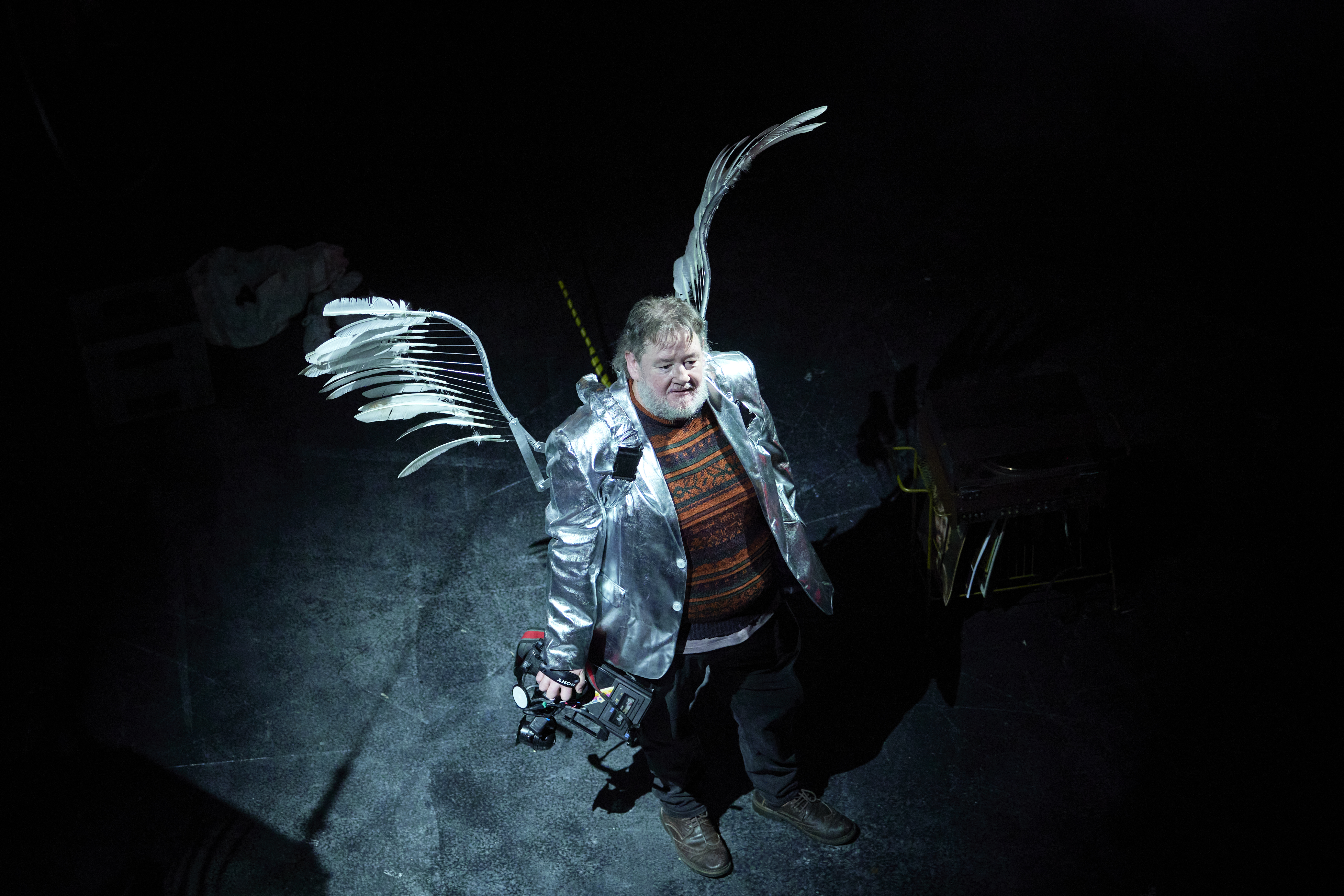
Johnny Vegas’s characteristically belligerent delivery is a perfect fit for the central role of Scullery. His words sloshing around like the contents of the rum bottle he clutches, as he interacts with his neighbours, jokes with the audience, and acts as an unsteady anchor for Cartwright’s collection of tales.
As Molly, an ageing woman surer of her memories than the here and now (“I need a new aerial”), Lesley Joseph movingly gazes out at us with fear and confusion. Physically she seems to be fading away in real time, almost spectral.
Shobna Gulati appears most at home with the push and pull of Road’s gritty scenarios, the jumble of highs and lows – able to capture the complexity of the women she inhabits in a succession of perfectly realised performances.
There’s something almost operatic in the comically bad-tempered back and forth between her and Laura Elsworthy (also on top form) as mother and daughter Brenda and Carol – each attempting to out insult the other as they argue over money. And yet, there’s also an undercurrent of it being a familiar routine, displaced affection, their underlying bond twisted cruelly out of shape by circumstances.
As Helen, an older woman who has picked up a paralytic young squaddie on a night out, Gulati skilfully navigates a mess of conflicting feelings. Her performance exuding a need to feel desired so strong that Helen’s attempts at seduction teeter on the verge of being distress calls – and when she finally lets go of the fantasy she has clumsily constructed, it’s almost too much to witness.
Throughout the production, a video feed, linked to a network of suspended television sets, is used to powerful effect. Camera in hand, Vegas’s Scullery captures key moments. Road’s residents often directly address their audience, and here, as they dig deep, and desperately dream, they stare into the lens, and via the multitude of TV screens, look us straight in the eyes – “Can we not have before again. Can we not?”.
Not everything lands perfectly. Scenes where two young people take to a bed in despair at their future drift rather than build. Elsewhere, Cartmell’s direction feels reluctant to disrupt the audience’s belly laughs, which results in several moments of tenderness and heartbreak being squandered.
For all that it’s a wonderful celebration of Cartwright’s Road, it doesn’t necessarily tell us anything new about the play – it showcases its strengths, the stories, the language, the savage, beautiful poetry of it all – but it also can’t disguise its flawed structure, its inherent bittiness.
Yet it is such an ambitious reimagining that it seems unfair to quibble, especially when it unfurls so engagingly within Leslie Travers’ astonishing transformation of the building.
For her first outing as Artistic Director, Selina Cartmell has created something more than a show. It is an event, a full-on experience – and if you were looking to cause mischief, you might even view it as a thrown down gauntlet to the increasingly lethargic Aviva Studios.
“Town, road, last stop…”
As Scullery brings us to the end of a night spent with Road’s community, the day breaks not within the theatre module but glimpsed outside in the Great Hall.
Cartmell’s stirring, sprawling production invites you to fall in love again with Jim Cartwright’s ground-breaking debut, while also enticing its audience into the Royal Exchange’s studio, its bar, the many nooks and crannies beneath its domed roof, and reminding you what an amazing space it is – so full of potential.
This isn’t just a journey from A to B down a road, however memorable – it’s a firing on all cylinders attempt to put Manchester’s premier theatre back on the map. Game on.
Road runs at Royal Exchange, Manchester from 13 February to 14 March 2026.
The run is sold out. Banquette seat day tickets are available from 12pm each day which audience members can purchase in person from the Royal Exchange Theatre’s box office or on the phone throughout the run.
Images by Ros Kavanagh.
 Circles & Stalls