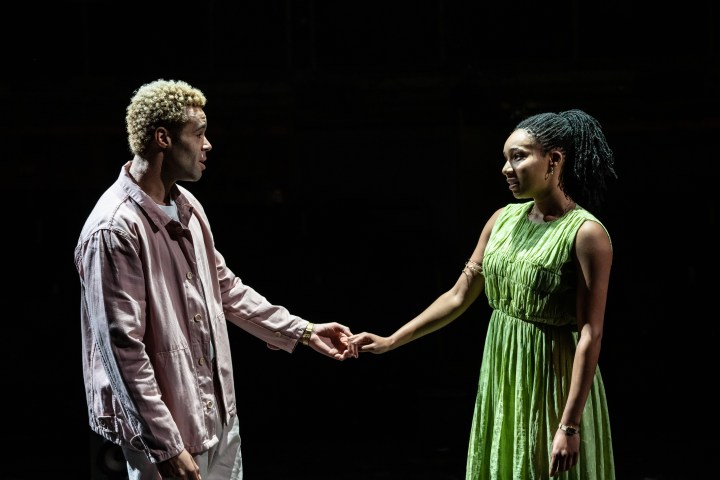
Review of Romeo and Juliet at Royal Exchange, Manchester.
Jettisoning fair Verona in favour of somewhere “just beyond Cheetham Hill”, director Nicholai La Barrie relocates Romeo and Juliet, while also bringing Shakespeare’s tale of “star-crossed lovers” bang up to date.
High street fashions, Mancunian accents, and youthful swagger offer some reassuringly familiar reference points for those who otherwise might think Shakespeare is not for them.
In many ways, this is a production that confounds expectations.
Despite a running time of three hours, it is spritely and often gripping (particularly during its first half). Romeo and Juliet’s story of love against the odds may have seeped into popular culture, yet it is delivered here with so much enthusiasm that it left me eager to actually read the original text.
And although this is La Barrie’s directorial debut at the Royal Exchange, his work so confidently occupies its main stage, and feels so determined to explore the theatre’s full potential, that I can only hope efforts are underway to tempt him back.
A tight focus on the play’s core narrative means several peripheral characters have been culled – while some of those who remain have been refreshingly reframed.
Here, Kate Hampson’s Lady Capulet is a single parent very much in charge of her household. As she plans a big party, business-like with clip board in hand, all athleisure wear and groomed blonde ponytail, she looks like a woman aspiring to a guest appearance on The Real Housewives of Cheshire.
Much is made of what humour can be found within the play, and opportunities to inject more are embraced. It’s an oddly neat fit for something with such a tragic trajectory – giving the production a cheeky down-to-earth charm, offering moments that wink and nudge at its audience. Welcome warmth before the chill sets in.
Gemma Ryan, as Juliet’s Nurse, benefits most from this approach. At ease with generating laughs – as she stroppily goes about her business in service to her beloved young mistress, Ryan delivers some comedy gold.
Be under no illusion though, for all the fleeting pleasures and disarming trappings, what the production seems to treasure most are Shakespeare’s words. There is a genuine commitment to making sure they are clearly conveyed, and that actors are carrying the audience with them as the story unfolds.
David Judge leads the charge, his quicksilver-tongued Mercutio finding crowd-pleasing rhythms within the badinage of the Bard. It is no surprise to see Judge’s CV peppered with Shakespeare plays, he has a thrilling ability to make the playwright’s words seem freshly minted – and his performance is as assured as his verbal skills, beguiling, yet laced with menace.
Underpinning the cast’s thoughtful handling of the text, is a determination to reach out and make a connection, sometimes quite literally. Romeo skirts the front-row, singing Juliet’s praises to audience members. While a confused servant asks them for directions – “where for art thou Ashton Close?”.
Even the prologue, “Two households, both alike in dignity…”, is delivered by a cast member who emerges unexpectedly from the cheap seats, dressed like someone you might think twice about sitting next to on the tram. The point is skilfully made, these people, and their stories, may well walk among you.
La Barrie really has a feel for the Exchange’s unique space. Not just in how his production blurs boundaries and pulls people in at the periphery of the stage – he also draws the eye upwards to observe Mercutio and Benvolio lounging over the edge of the gallery, or a glowing Juliet atop a weathered metal tower, right in the centre of our collective gaze.
He fills the theatre to bursting, with a suitably chaotic and crowded masked rave (“this ain’t no Montague party, it’s a Capulet party darling”) – and later crafts a widescreen moment, with incoming rumbles of thunder, a mist-laced downpour, and a funeral procession sheltering beneath a cluster of black umbrellas.
Shalisha James-Davis and Conor Glean provide refreshingly contemporary (and very relatable) takes on the loved-up couple. Glean’s Romeo is laddish, still trying manhood on for size. When he asks the nurse to “commend me to thy lady”, he flexes his muscles at her, posing like some Love Island wannabe on Instagram. Juliet is more mature in approach – knowing what she wants and setting the pace for their relationship.
Despite their street-smart bravado, there is a touchingly gentle, almost innocent, quality to the couple’s romantic encounters. Blissed out and swaying together on a table at a party, tenderly rubbing noses, tentatively kissing cheeks – they woo one another. After their first night together, James-Davis’s Juliet sheds tears of joy.
I’ve seen a lot said about this being a love letter to Manchester. If it is, it might repay closer reading. Often, it feels like two intertwined stories of one city – both equally compelling.
Yes, there is love and hope, and infectious optimism – but on the streets that the Capulets and Montagues inhabit there is also broken glass, brandished blades, and spilt blood. Some of the fight scenes are staged with a sense of spectacle but it’s unnerving how often weapons are present within the characters’ daily lives – even Juliet’s nurse is packing a knife.
La Barrie’s production does not shy away from the ugliness of death – Mercutio slumped to the floor, life bleeding out from him with distressing speed; Juliet’s body convulsing over Romeo’s, breath leaving her in violent spasms. All that youthful spark extinguished.
There are none of the usual flowery conciliatory speeches at the end of this Romeo and Juliet, no formal end to feuding, no neatly tied bows. The cycle of violence remains unbroken.
Performance seen on 25 October 2023.
Romeo and Juliet runs at the Royal Exchange from 20 October to 18 November 2023.
Images by Johan Persson.

 Circles & Stalls