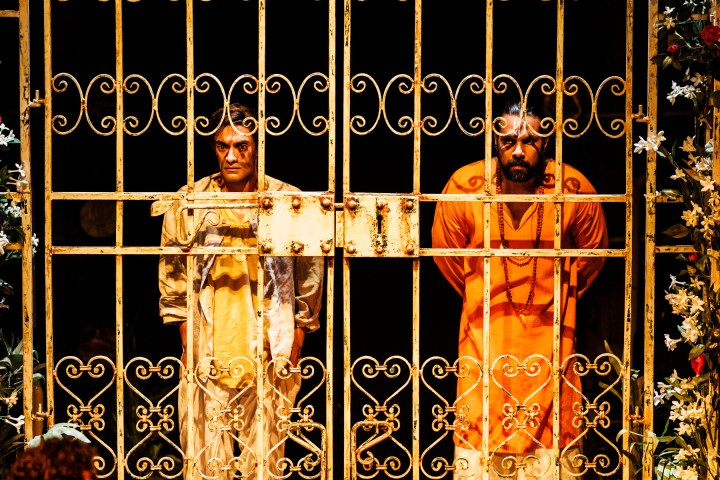
Review of Great Expectations at Royal Exchange, Manchester.
Rather than the mist and fog of the Kent marshes, Tanika Gupta’s adaptation of Great Expectations is cloaked in swirling clouds of incense. On stage, the Goddess Lakshmi nestles in a reed bed, and the Wheel of Dharma radiates out from beneath the layers of Rosa Maggiora’s ornate set design.
Gupta has rewoven and repurposed the vibrant threads of Dickens’ classic novel, relocating the familiar characters, and their fates, to India in 1903.
Against a background of unease and uncertainty over British plans to partition the state of Bengal, we are introduced to Pipli, a young Indian boy from humble circumstances.
His life is about to be turned upside down, with the arrival of a summons from the rich and eccentric local English landowner Miss Haversham, who requires him to visit her household, and spend time with her ward Estella.
Much of the familiar Dicken’s narrative remains – although the adaptation adds new layers and perspectives, using the backdrop of the British Raj to explore racism, colourism and colonialism.
A mystery benefactor affords Pipli access to education, opportunities and a new life in Calcutta. Yet he is constantly reminded that he will only progress so far in society. “You’ll never be English”, Miss Haversham reminds him, “remember your station in life”.
When Pipli is visibly transformed before our eyes, a tailor gradually clothing him in the wardrobe of a gentleman, he stands tall and proud – but he is balanced on a tiny wooden stool, visibly precarious despite his new finery.
While the insidiousness and cruelty of prejudice is subtly documented through the story-telling, the specifics of some of the political and historical context at the time are less seamlessly conveyed – too often relying on hastily delivered speeches, or snatched glimpses of events.
Catherine Russell’s cruel and capricious Miss Haversham seems to personify elements of British rule, yet Russell’s thoughtful interpretation also offers us someone broken by betrayal, and unnervingly stupefied.
While some characters are merely tweaked – Giles Cooper’s gloriously good-hearted Herbert Pocket feels quintessentially Dickensian – others are transformed. Andrew French’s escaped convict Malik is a more nuanced and more immediately sympathetic character than Magwitch, on which he is based, and French delivers one of the production’s strongest performances, bringing real depth to the role.
Joshua Carr’s lighting and Arun Ghosh’s music do a lot of the heavy lifting when it comes to signifying changes in location and mood. Elements of the set take on a metallic shimmer, all gold and bronze, in the bright light of Pipli’s home village; while the stopped clockfaces in Miss Haversham’s home slumber in a moon-like bluey white glow. Ghosh’s compositions stylishly wrap around the action – from keyboards quietly haunting the elderly woman’s mansion, to more lively tabla-driven rhythms accompanying Pipli’s many endeavours.
Forging ahead with some determination, director Pooja Ghai’s production provides a steady stream of activity – although occasional lulls suggest there’s still room to tighten up the overly lengthy running time.
Jostled, dressed, twirled, carried, undressed and even gently put to bed – Pipli is often at the mercy of events and the actions of others. Yet, Esh Alladi deftly captures the main character’s personal transformation from inquisitive child, to impressionable young man, and finally, someone at peace with himself and his feelings.
It’s a subtly evolving performance – and amidst the hectic intrigue and drama of Gupta’s Dickensian Bengal, Alladi’s Pipli is a very likeable constant companion.
Performance seen on 13th September 2023.
Great Expectations runs at Royal Exchange from 8th September to 7th October 2023.
Images by Ellie Kurttz

 Circles & Stalls